You Go Blind Every Time You Move Your Eyes (Saccadic Masking)
Look at your left eye in a mirror, then your right eye, back and forth. You will never catch your eyes moving — even though someone watching you sees them flick clearly.
The Unintuitive Universe · July 14, 2026
And it’s been measured. Every claim traced to the published research. Method & sources ↗
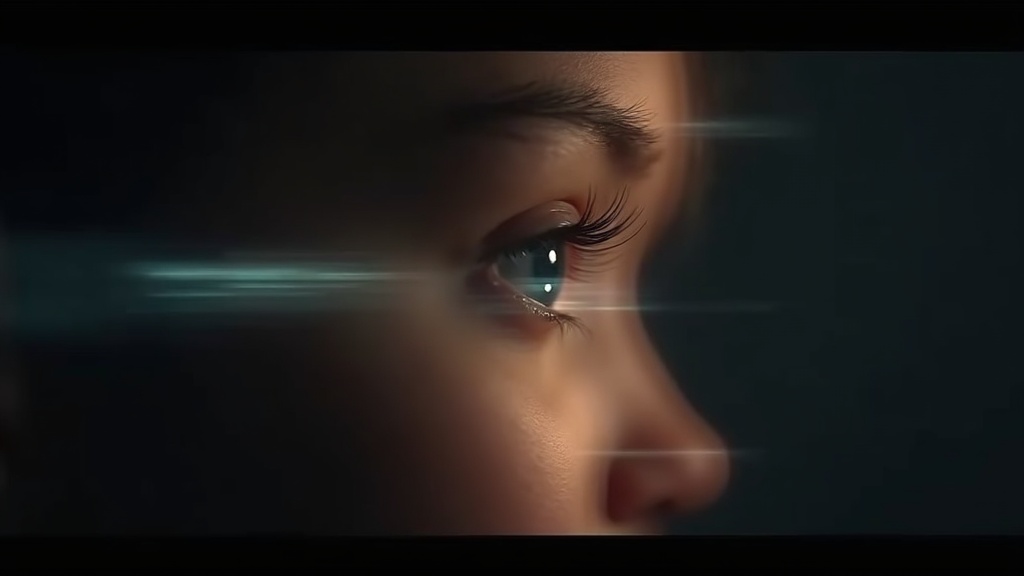
Try something right now. Look at a mirror, and look at your own left eye. Then look at your right eye. Then back to the left. Go back and forth.
You will never, ever catch your eyes moving. You see your left eye, then you see your right eye — but the flick between them, the actual motion, is simply missing. It's not that it happens too fast to notice. Someone standing beside you, watching your eyes, sees them jump back and forth clearly. To them, the movement is obvious. To you, looking at the very same eyes, it does not exist.
So where does that moment go? The answer is genuinely unsettling: every single time your eyes move, your brain switches your vision off. It happens several times a second, all day long, and you have never once noticed the darkness. Let me show you the blindness hiding inside your own sight.
The Jumping Eye
Start with how your eyes actually move, because it's not how it feels. It feels like your gaze glides smoothly across a room, panning like a camera. It doesn't. Your eyes move in fast, sharp jumps called saccades — flicking from one fixed point to another, several times every second, faster than you can control.
Between the jumps, they hold still for a fraction of a second and grab a snapshot. Then they jump again. Right now, reading this, your eyes aren't sweeping along the line — they're hopping across it in a series of quick jerks, pausing to snatch a few words at a time. You are not watching the world like a film. You are taking still photographs, three or four a second, your whole life.
And that creates a problem the brain has to solve.
The Blackout
Think about what should happen during one of those jumps. When your eye whips from one side of the room to the other, the image on your retina gets dragged across it at enormous speed. If your brain showed you that raw feed, you'd see a violent, nauseating smear of motion blur, several times a second, forever.
It doesn't show you that. Instead, in the instant your eye is moving, your brain simply throws the visual signal away. It suppresses vision during the saccade — a phenomenon called saccadic masking — so you never see the smear. You go briefly, completely, blind. And then, the moment your eye lands and locks onto its new target, vision snaps back on, and you get a crisp, clean, still image.
That's why you can't catch your eyes in the mirror. In the exact moment they're moving, you aren't just failing to notice — you are blind. The brain has pulled the shutter down.
Now do the arithmetic. These blackouts happen a few times a second, every waking second, tens of thousands of times a day. Add up all those tiny gaps, and depending on how you count, you spend somewhere between many minutes and a couple of hours each day with your vision switched off. Not blinking — blinking is separate. This is your eyes open, aimed at the world, seeing nothing, over and over, and never once catching yourself in the act.
The Stitched World
Which raises the real mystery. If you go blind that often, why does the world look perfectly smooth and continuous? Why isn't your vision a strobe of blackouts?
Because your brain hides the gaps — and it does it with a beautiful trick. When your eye lands and vision comes back, the brain takes that fresh image and quietly back-dates it, stretching it backward in time to cover the blank moment you just had. It papers over the blackout with the picture that came after it, so the seam disappears.
You can actually catch this happening. Glance quickly at a ticking clock — the kind with a sweeping second hand. For a moment, that first second seems to last too long. The hand appears frozen, hanging in place longer than a second should. That's called the stopped-clock illusion, and it's the edit showing through: your brain filled the blind gap of the eye movement with the image of the clock, and then dated that image back to before your eye even landed — so the first tick feels stretched. You are, for a moment, seeing time that your brain invented to hide its own blackout.
The Story You're Shown
So here is what your vision actually is. Not a live window onto the world. A construction. Your eyes take a rapid series of still snapshots, the brain deletes the blurred motion between them, blinds you during every jump, and then stitches the surviving frames together — back-dating, smoothing, filling the gaps — into one seamless, stable, continuous scene, and hands you that. And it is so good at the editing that you would swear you were watching reality directly, in one unbroken take.
You are not. You are watching a reconstruction, assembled from fragments, with the darkness cut out and the joins hidden. The steady, whole world in front of you right now is a story your brain is telling — a story so well told that the blindness woven all the way through it is completely invisible to the one person living inside it.
That's the fine print on your own eyes — and reading it is exactly what this channel is for.
Sources
- Yarbus, "Eye Movements and Vision" (1967)
- Burr, Morrone & Ross, "Selective suppression of the magnocellular visual pathway during saccadic eye movements," Nature 371, 511 (1994)
- Yarrow et al., "Illusory perceptions of space and time preserve cross-saccadic perceptual continuity," Nature 414, 302 (2001) — chronostasis / the stopped clock