You Were Carved by Death (How Apoptosis Shaped You)
You think of your body as something that was built — cells added, tissue grown, fingers extended outward. That's only half the story.
The Unintuitive Universe · July 14, 2026
And it’s been measured. Every claim traced to the published research. Method & sources ↗
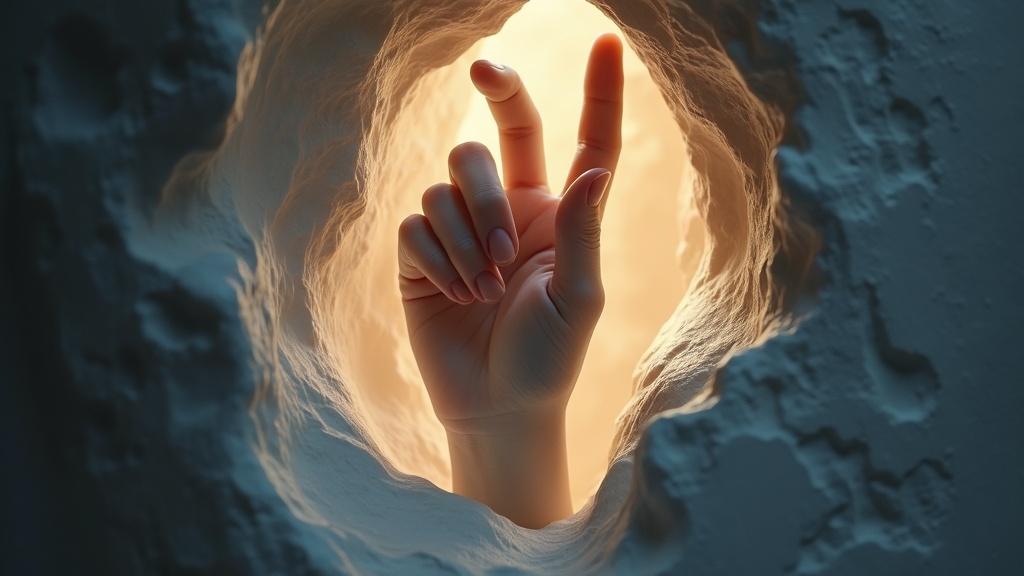
Look at your hand. Five separate fingers, able to spread apart, to grip, to point. You probably think of them as something your body grew — cells added, tissue built up, fingers extended outward like branches.
That's only half the story. Because before you had fingers, you had a paddle. In the womb, your hand started as a flat, mitten-like pad, the future fingers fused together by webbing, like a duck's foot. You have five separate fingers for one reason: the cells in the webbing between them were ordered to die. They killed themselves, on schedule, and in dying, they carved the gaps that set your fingers free.
You were not only grown. You were carved — and the chisel was death. Right now, as you watch this, tens of billions of your own cells are quietly executing a suicide program, on purpose, so that you can keep existing. Let me show you the death that made you.
The Cell That Ends Itself
There are two ways for a cell to die. One is messy. If a cell is injured, burned, poisoned, starved, it dies by necrosis: it swells, ruptures, spills its contents, and triggers inflammation. That's death as an accident.
But there's a second kind, and it's the opposite of an accident. It's called apoptosis, from the Greek for the way leaves fall from a tree, and it is death by design. On a signal, the cell activates a set of internal demolition enzymes — fittingly nicknamed executioners — that calmly and precisely take it apart from the inside. It shrinks, packages itself into neat parcels, and is quietly swallowed by neighbors, with no mess and no alarm. The cell doesn't die because something went wrong. It dies because it was told to, and it obeyed.
And your body gives that order constantly — not to damage itself, but to build and maintain itself. Apoptosis isn't a malfunction of life. It's one of life's main tools. Nowhere is that clearer than in how you were shaped.
Sculpted, Not Just Grown
Think about what it takes to make a hand.
You could try to grow five fingers outward, one by one, from nothing. That's hard. Evolution found an easier way: grow a solid paddle, then delete the parts you don't want. So in the developing embryo, the hand forms as a webbed pad, and then, in precise stripes between the future fingers, the cells receive the order to die. They undergo apoptosis, the webbing dissolves, and five fingers emerge from the gaps left behind. You have separate fingers because death was applied in exactly the right pattern.
When this process fails — when those webbing cells don't die on cue — the fingers stay fused together. It's a real condition called syndactyly, webbed fingers, and it's not that anything was added. It's that the necessary death didn't happen. A duck's webbed foot is the same story told differently: ducks simply keep more of the webbing, hold back the apoptosis, because for a duck the web is useful. Same mechanism. The difference between your hand and a duck's is a difference in where cells were allowed to die.
And it isn't just hands. Your developing brain overproduced neurons wildly, then pruned away roughly half of them through apoptosis, keeping the connections that worked and killing the ones that didn't. A tadpole becoming a frog resorbs its entire tail this way — the tail doesn't fall off, it's dismantled, cell by programmed cell. Across the living world, bodies are shaped less like clay being added and more like marble being carved. And the sculptor only ever removes. The sculptor is death.
Every Time, the Same Deaths
Here's how exquisitely controlled this is. To study it, biologists turned to a tiny transparent roundworm called C. elegans, simple enough that they could track the fate of every single cell in its body as it develops.
What they found is almost eerie. As the worm grows, it generates a fixed number of cells — and then a specific set of them dies. Not a random few. Exactly one hundred and thirty-one cells, the same one hundred and thirty-one, in every single normal worm, are programmed to die, at the same points in development, every time. The biologists could name each doomed cell in advance and watch it die on schedule. Death, in that worm, is not chaos or bad luck. It is a precise, inherited part of the blueprint — as deliberate as any cell that lives.
That work — mapping how genes command specific cells to die — won the Nobel Prize in 2002. Because it revealed something universal: building an animal is as much about scheduled death as it is about growth. And the same is true, on a vastly larger scale, in you.
The Death That Keeps You Alive
Which brings us to the number that should stay with you. In your adult body, right now, an estimated tens of billions of cells are dying by apoptosis every single day, and being replaced. You are not a fixed object. You are a standing wave — held in shape by a constant, balanced churn of birth and scheduled death, rebuilt continuously out of your own dying.
And that machinery is also your guardian. When a cell's DNA gets dangerously damaged — the kind of damage that could turn it cancerous — a healthy cell is supposed to trigger its own apoptosis. To fall on its sword for the good of the whole body. This is one of your deepest defenses. And it tells you what cancer really is, at its core: cells that have broken their death program. Cells that were ordered to die, and refused. A tumor is, in a real sense, a rebellion against apoptosis — life that won't accept the death that's supposed to keep the rest of you safe.
So the same tool that carved your fingers, pruned your mind, and shapes every animal that has ever lived is also the thing standing between you and your own cells turning against you. Death, applied correctly, is not the enemy of your life. It is its scaffolding.
What Was Left
So look at your hand one more time.
The spaces between your fingers are not empty because nothing grew there. They are empty because something died there — deliberately, on schedule, in exactly the right place. You are not simply the sum of what your body built. You are what remained after the right cells were sacrificed. A statue is not only the stone that's present; it's defined by everything the sculptor cut away. And you were sculpted, cell by dying cell, into the precise shape of a human being.
You were carved by death. And you are being carved, quietly, tens of billions of times a day, for as long as you live.
That's the fine print on your own body — and reading it is exactly what this channel is for.
Sources
- Kerr, Wyllie & Currie, "Apoptosis: a basic biological phenomenon…," Br. J. Cancer 26, 239 (1972) — the paper that named it
- Sulston & Horvitz, cell-lineage work in C. elegans; the 2002 Nobel Prize in Physiology or Medicine (Brenner, Horvitz, Sulston): https://www.nobelprize.org/prizes/medicine/2002/
- Hanahan & Weinberg, "Hallmarks of Cancer" — evading apoptosis as a hallmark