
Tiny Metal Rings Where Shape Alone Changes How Electricity Flows
MIT researchers measured sub-micron rings etched from the kagome superconductor CsV3Sb5, demonstrating quantum interference tuning that bypasses local electronic scattering without shifting carrier density.
Priya Ramaswamy 2 min read

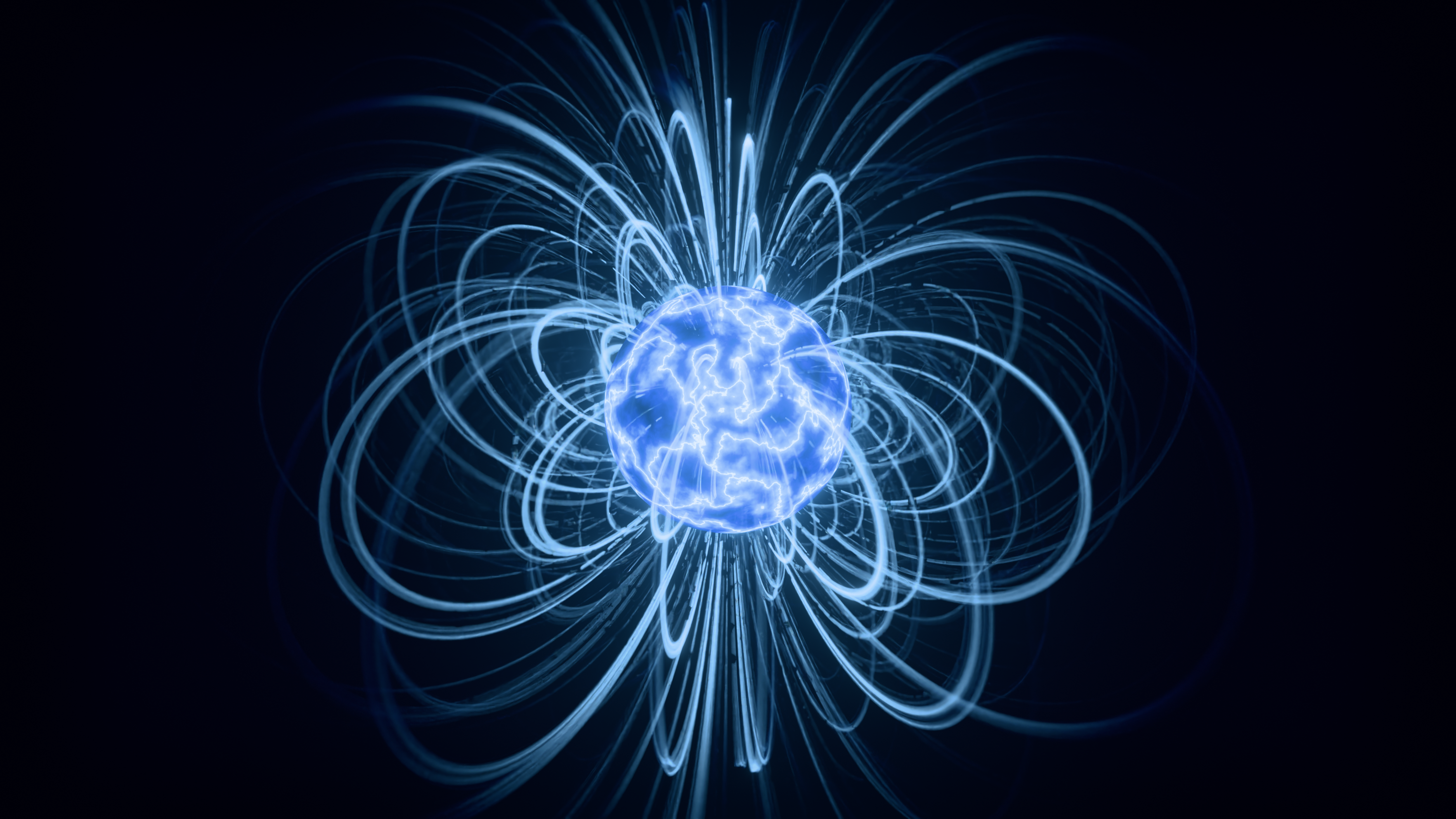
Send an electron down a splitting path in a metallic wire, and its quantum wavefunction divides in two. Recombine those paths, and the phases of the two sub-waves determine whether they reinforce one another or cancel out. In ordinary copper or gold, microscopic imperfections scatter the electron long before it can complete a coherent loop, washing out the phase arithmetic entirely.
That changes when the conductor is carved out of CsV3Sb5, a vanadium-based superconductor whose atoms lie in a two-dimensional kagome lattice—a geometric pattern of corner-sharing triangles.
Physicists led by Joseph Checkelsky at MIT fabricated sub-micron ring geometries out of single-crystal CsV3Sb5 flakes to track how quantum phase shifts dictate electrical resistance. By threading a perpendicular magnetic field through the center of the ring, the team induced the Aharonov-Bohm effect: a fundamental phenomenon discovered theoretically by Yakir Aharonov and David Bohm in 1959, where a magnetic vector potential imparts a geometric phase shift to an electron’s wave function even if the magnetic field itself is zero along the electron’s path.
Measured.
In standard metallic rings, varying the magnetic flux produces periodic oscillations in electrical resistance as constructive and destructive interference alternate. The total charge carrier density remains fixed while the phase relationship shifts.
In the kagome ring apparatus, however, the geometry of the underlying electronic band structure alters the interference condition. The corner-sharing triangular layout of the kagome plane forces the electron wavefunctions into destructive interference configurations that decouple momentum relaxation from scattering centers. As the magnetic flux tunes the geometric phase shift across the two arms of the ring, destructive interference suppresses local backscattering events. The electrical resistance dips periodically without any adjustment to the material’s bulk carrier concentration or gating voltage.
The experimental setup relied on focused ion beam milling to sculpt the single crystals into clean, micron-scale annular channels while preserving the native charge density wave order of the material. Electrical transport measurements were taken at cryogenic temperatures where the phase coherence length of the charge carriers exceeds the circumference of the ring.
When the magnetic flux through the ring reaches integer and half-integer multiples of the magnetic flux quantum $h/e$ (where $h$ is Planck’s constant and $e$ is electron charge), the output voltage drops to sharply defined minima. The magnitude of this cancellation demonstrates that the electronic phase control is linked directly to the topological structure of the kagome flat bands and Dirac nodes.
Rather than relying on electrostatic gating—which physically injects or removes electrons to change conductivity—the ring geometry acts as a purely phase-driven valve. The electron momentum distribution remains invariant, yet current flows through the channel because destructive paths for backward-scattered waves are enforced by the topology of the system.
In conventional quantum ring experiments, scattering from surface defects or lattice irregularities degrades the visibility of Aharonov-Bohm oscillations. In CsV3Sb5 rings, the intrinsic electronic order of the kagome lattice protects the phase relationships over longer path lengths, allowing the interference signatures to persist even when thermal fluctuations threaten to randomize phase memory.
Measured.
This article is AI-generated (synthetic) content, produced by an automated editorial system with human direction and review. Every claim is traced to published, peer-reviewed sources.