Your Eyes Are Wired Backwards (and an Octopus Proves It)
Look at anything. It feels like a flawless, effortless window onto the world.
The Unintuitive Universe · July 13, 2026
And it’s been measured. Every claim traced to the published research. Method & sources ↗
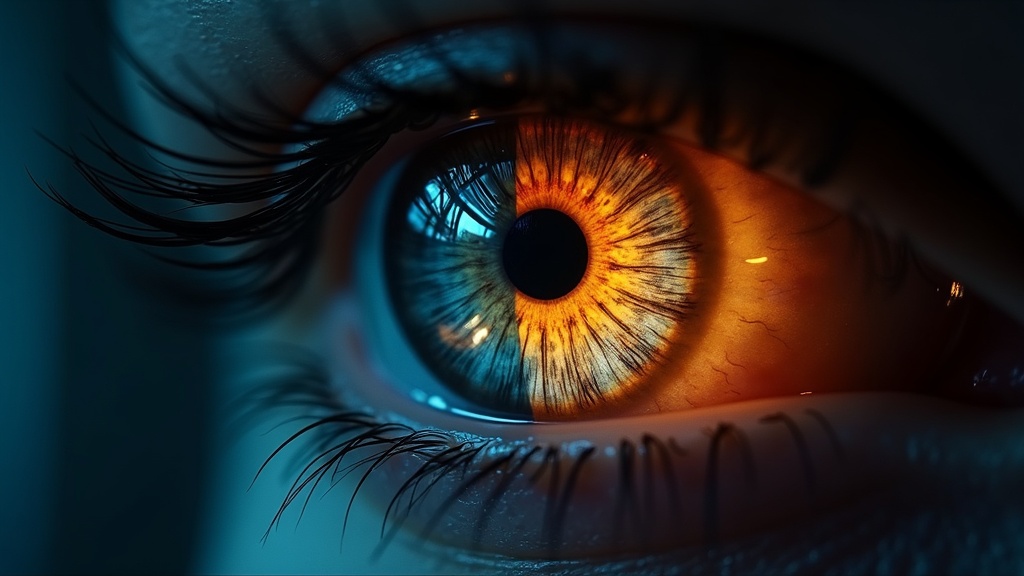
Look at anything. A word, a face, the light in the room. It feels flawless, effortless, complete — a clean window onto the world. It is not. The eye you are using to read this is built backwards. Its light-detectors face the wrong way. Its wiring runs in front of the very cells it serves, and then punches a literal hole straight through your vision — a blind spot, in each eye, that you have never once noticed.
And the proof that this is a mistake, and not some deep necessity, is swimming in the ocean right now, watching the world through an eye that got it right. Let me show you the flaw in the most trusted sense you have.
The Sensor, Mounted Backwards
Here's how a sensible camera works. Light comes in, and it lands directly on the sensor — the light-catching surface faces the light. Obvious.
Now here's your eye. Light comes in through the lens and travels to the retina at the back. But the light-sensing cells of your retina — the rods and cones — do not face the incoming light. They point away from it, toward the very back of the eye. The business end of your photoreceptors is aimed at the wall.
Which means the light has to finish its journey by passing through the retina's plumbing first: layers of neurons, support cells, and blood vessels are stacked in front of the photoreceptors, and every photon has to thread through all of it before it can be detected. Your sensor is installed facing backwards, with its own wiring draped across the lens side. No engineer would build a camera this way. But it gets worse.
The Hole in the Middle of Your Sight
If the photoreceptors face backwards, then the nerves carrying their signals come off the back too — on the wrong side, the side away from the brain. So those nerves have to gather together, cross to the front of the retina, and then dive back through it, punching a hole in the light-sensitive sheet to escape toward the brain as the optic nerve.
At that hole — where the cable exits — there is no room for any photoreceptors. None. It is a patch of retina that is completely blind. Every one of your eyes has one, a dead zone a few degrees wide, off to the side of your center of vision.
You have a hole in your sight, right now, in each eye. And you cannot find it, because your brain refuses to let you see it. It uses your other eye to cover the gap, and where it can't, it simply invents the missing patch — painting in whatever it guesses should be there, based on the surroundings. Every waking second, part of your visual world is not seen at all. It's fabricated, seamlessly, so you never catch the seam.
So why would evolution build the light-detecting organ inside-out, and then paper over the damage? To answer that, look at an octopus.
The Eye That Got It Right
The octopus has a camera eye remarkably like yours — a lens, an iris, a retina at the back. But here's the astonishing part: the octopus and the vertebrate eye evolved completely separately, on totally different branches of the tree of life, hundreds of millions of years apart. Two independent inventions of the same idea. Biologists call it convergent evolution.
And when the octopus's lineage built its eye, it wired it the sensible way. Its photoreceptors face toward the light, the way they should. The nerves run out the back, behind the retina, tidily, without ever crossing in front. Nothing punches through the light-sensing sheet.
Which means the octopus has no blind spot. No hole. No fabricated patch. Given a blank slate and the same problem — build a camera eye — evolution, on the cephalopod branch, arrived at the clean design your intuition would have chosen. On our branch, it didn't.
Why We're Stuck With It
So why don't we have the octopus's better eye? Not because ours can't be improved — because it can't be un-built.
The vertebrate retina grows, in the embryo, as an outpouching of the developing brain, and that particular geometry sets the photoreceptors facing backwards from the very start. Once an animal's whole visual system is committed to that layout, you can't flip the retina with a small mutation. You'd have to re-architect the entire eye at once, and keep vision working at every intermediate step. Evolution can't do that. It has no blank slate and no undo. So the backwards retina, having appeared early, simply stayed — inherited by every fish, frog, bird, and human that followed.
And to be fair to your eye: it works beautifully anyway. The layers in front are nearly transparent, and the brain's patching is so good you'll live your whole life without noticing the hole. This isn't a broken eye. It's a superbly functional one, built on a foundation no one would choose — and quietly outclassed, in raw logic, by an octopus.
The Seam You Can't See
So here's what's true every time you open your eyes. You are looking through a sensor mounted backwards, behind its own wiring, with a blind hole punched through the middle of each field of view — and a brain working full-time to hide all of it from you, so the world looks like a perfect, seamless window.
It isn't a window. It's a reconstruction, running on inherited hardware that an octopus would find faintly embarrassing. The flaw isn't a failure of your eye — it's a fingerprint of how your eye was made: not designed from scratch for the job, but grown out of a brain, backwards, and never allowed a redo.
The most trusted thing you own — your own vision — has a seam in it you were never meant to find. And once you know it's there, you can actually go look for your blind spot, and watch your brain lie to you in real time.
That's the fine print on seeing. And it's exactly the kind of thing this channel exists to read out loud.
Sources
- The inverted retina & blind spot (UC Berkeley Understanding Evolution): https://evolution.berkeley.edu/how-your-eye-works/
- Octopus eyes, wired better than ours: https://thesea.org/octopus-eyes/