Your Memory Is Not a Recording (It's Rewritten Every Time)
Bring to mind a vivid memory — a childhood birthday, a first kiss, a day you're certain of. It plays like a video, frame by frame, the way it really was.
The Unintuitive Universe · July 13, 2026
And it’s been measured. Every claim traced to the published research. Method & sources ↗
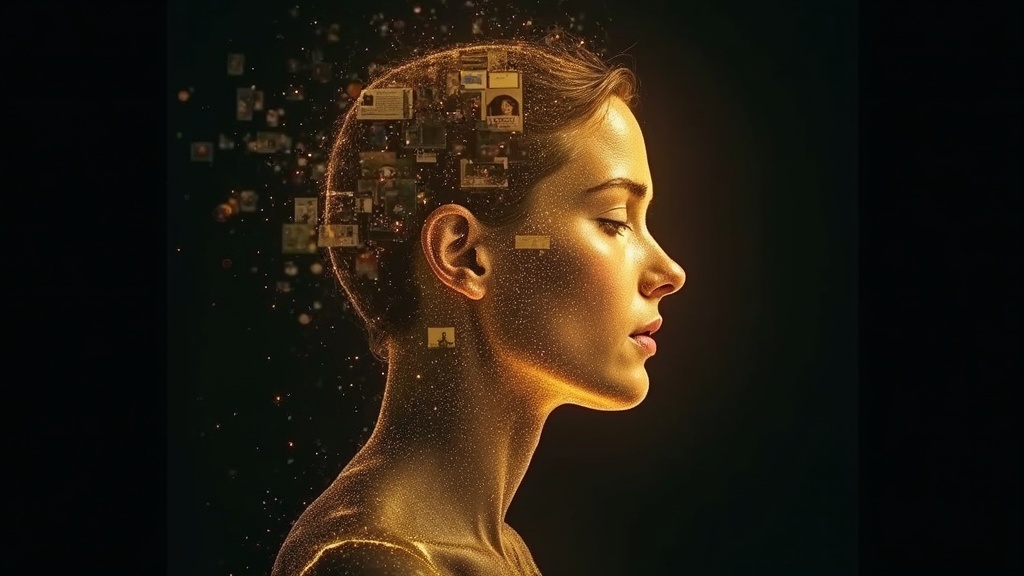
Bring to mind a vivid memory. A childhood birthday. A first kiss. The day something happened that you are certain of. It plays in your head like a video — you can almost see it, frame by frame, the way it really was.
Here is the unsettling truth. You are not playing a recording. There is no video. Every time you remember something, your brain builds the scene fresh, from scattered fragments, filling the gaps with guesses — and it can build it differently each time. Your most treasured, most certain memories are, in part, things your mind constructed. Some of them may never have happened at all.
Your past is not stored. It's re-authored, a little, every time you visit it. Let me show you how loose your grip on it really is.
The Playback Illusion
We imagine memory like a camera. Something happens, it gets recorded, and later we press play and watch it back. Clean, faithful, permanent.
That is not how it works, not even close. Memory is reconstructive. When you recall an event, your brain does not retrieve a finished file. It grabs a handful of surviving fragments — a face, a feeling, a color, a fact — and it reassembles them into a scene on the spot, using your expectations and your general knowledge to fill in everything that's missing. The vividness you feel is not evidence that it's accurate. It's evidence that your brain is very, very good at building a convincing scene.
And anything that helps build a scene can also distort it. Including a single word from someone else's mouth.
The Word That Rewrote a Crash
In 1974, the psychologist Elizabeth Loftus ran an experiment that should be more famous than it is. She showed people a film of a car accident, then asked them how fast the cars were going. But she changed one word for different groups. Some were asked how fast the cars were going when they "hit" each other. Others, when they "smashed" into each other.
The word "smashed" made people remember a faster crash. That alone is striking — a verb nudging a number. But here's the part that matters. A week later, she asked everyone: did you see any broken glass? There was no broken glass in the film. And the people who had been given the word "smashed" were more than twice as likely to remember glass that was never there.
One word, planted after the event, and their memory of the scene physically changed to accommodate it. This is the misinformation effect, and Loftus spent the next thirty years demonstrating it again and again. What you're told after something happens gets folded into your memory of the thing itself, and you cannot feel the seam.
If a single word can add broken glass to a memory — how much more can be added?
Memories of Things That Never Happened
The answer is: entire events. Whole experiences, invented, that you will then remember as real.
In one of the most famous studies in psychology, Loftus and her colleagues gave adults a booklet describing a few childhood events, supposedly gathered from their families. Most were true. But one was completely fabricated: a story about being lost in a shopping mall as a small child, frightened, before being rescued by a kindly elderly stranger. It never happened.
About a quarter of the participants "remembered" it. Not vaguely — many described it in rich detail, the fear, the stranger's face, the layout of the mall, adding specifics no one had given them. Their minds took a suggestion and grew a full, false memory around it, indistinguishable, from the inside, from a real one. Later studies planted memories of spilling punch at a wedding, of a hot air balloon ride, even of committing a crime in adolescence. The mind does not come with a reliable stamp that says "this one actually happened."
So if your memories can be edited by a word, and whole false ones can be grown from a suggestion — what happens every time you simply remember on your own?
You Overwrite the Ones You Love
This is the strangest part. The very act of remembering changes the memory.
When you pull up a memory, neuroscience shows it doesn't just play and get filed back untouched. Retrieving it makes it briefly unstable — malleable — before your brain saves it again. It's called reconsolidation. And in that unstable moment, the memory can pick up edits: whatever you're feeling now, whatever you've learned since, the way you told the story last time. Then it re-saves, subtly rewritten.
Follow that to its conclusion. The memories you revisit the most — your happiest, your most defining, the stories you tell about who you are — are the ones you have overwritten the most times. Each recall is a small revision. So in a real sense, you are not remembering the original event anymore. You are remembering the last time you remembered it, a copy of a copy of a copy, drifting a little further from the source with every loving replay. The memories you cherish are, precisely because you cherish them, the least trustworthy you have.
The Courtroom
If this were just a private quirk, it would merely be humbling. But we stake people's lives on the assumption that memory is a recording. And that assumption puts innocent people in prison.
When the Innocence Project used DNA evidence to overturn wrongful convictions, they looked at what had gone wrong in each case. The single leading cause was not corruption or bad lawyers. It was memory. Roughly sixty-nine percent of those DNA exonerations — hundreds of cases — involved an eyewitness who identified the wrong person. These were not liars. They were sincere, confident witnesses who looked at an innocent human being and truly, honestly remembered them committing a crime. Their memory had reconstructed a face, and reconstructed it wrong, and no amount of certainty on the stand made it true.
Confidence, it turns out, is not proof. It never was.
A Living Document
So let's put your memory back in your hands, but honestly this time.
It is not an archive of what happened. It is a living document — written in the moment, and quietly revised every time you open it, by words, by suggestion, by feeling, by time. Most of it is good enough. The gist is often right, and you can live an entire life leaning on it without disaster. But the vividness is not proof, the confidence is not proof, and the details, especially the cherished ones, are softer than they feel.
The you that you remember being — the specific scenes, the exact words, the way it all happened — is partly a story your present self keeps telling, and gently editing, in the retelling. Your past isn't a place you go back to. It's a place you rebuild, every single time, out of the materials you have today.
And once you know that, you hold your own certainty a little more lightly. Which, it turns out, is a wiser way to carry a mind. That's the fine print on remembering — and reading the fine print is exactly what this channel is for.
Sources
- Elizabeth Loftus — misinformation effect & false memory: https://en.wikipedia.org/wiki/Elizabeth_Loftus
- Eyewitness misidentification in wrongful convictions (Innocence Project): https://innocenceproject.org/eyewitness-misidentification/