The Universe Is Not Locally Real (and a Nobel Prize Proved It)
There is a sentence physicists can now say out loud, backed by a Nobel Prize, that sounds like a fever dream: the universe is not locally real. "Local" means nothing can influence anything faster than light.
The Unintuitive Universe · July 13, 2026
And it’s been measured. Every claim traced to the published research. Method & sources ↗
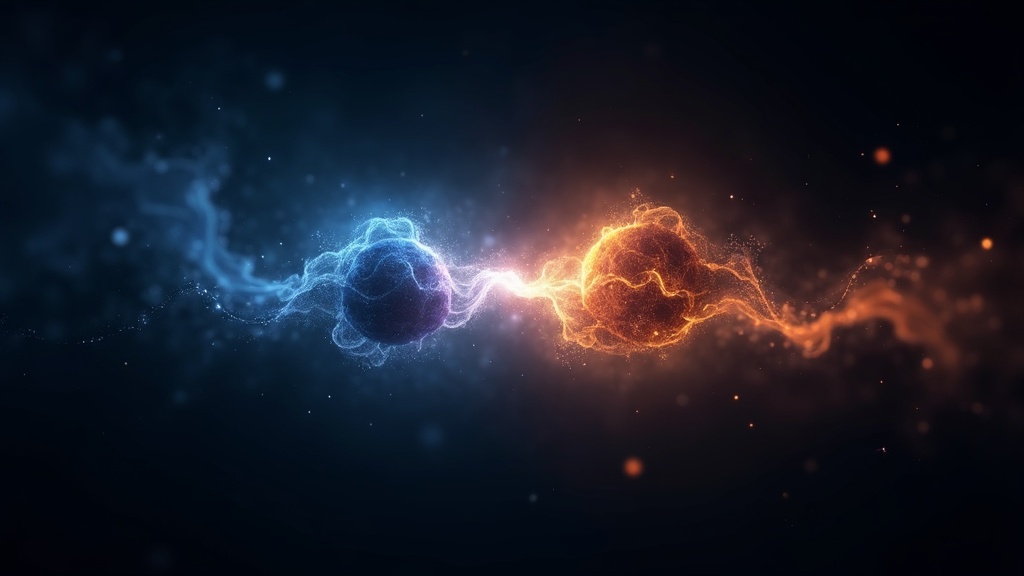
There is a sentence physicists can now say out loud, backed by a Nobel Prize, that sounds like it belongs in a fever dream: the universe is not locally real.
Unpack those two words. "Local" means nothing can influence anything else faster than light — no instant action across a distance. "Real" means things have definite properties whether or not you're looking — the moon is there when nobody checks. Local. Real. Together they're just... the world. The obvious, common-sense world.
And in 2022, three physicists won the Nobel Prize for proving that world does not exist. At least one of those two comforting words is false. Possibly both. This isn't a philosopher's opinion. It's an experimental result, repeated, loophole-free. Let me show you how they cornered reality.
Einstein's Last Stand
It starts with Einstein losing an argument.
Quantum mechanics says a particle doesn't have a definite property — say, which way it's spinning — until you measure it. Before that, it's a haze of possibilities. Einstein hated this. In 1935, he and two colleagues argued the haze must be an illusion. The particle really does have a definite spin all along; quantum theory is just too crude to see it. There must be, they said, hidden variables — little predetermined answers the particle carries, that we simply can't read yet.
It's a deeply reasonable idea. The particle knows what it is; we just haven't looked. For thirty years, this was a standoff — two philosophies making identical predictions, untestable, a matter of taste.
Then a physicist named John Bell found the crack.
The Crack: Bell's Theorem
Here's the setup that breaks it open. You take two particles, entangle them — link them so their properties are correlated — and send them flying to opposite ends of a lab, or a city. Then you measure each one, and you can choose, at the last instant, which angle to measure at.
Bell asked a devastatingly simple question in 1964. Suppose Einstein was right: each particle carries hidden, predetermined answers for every possible measurement. If that's true, then when you compare the two distant results across many runs and many angles, the correlations between them cannot exceed a certain amount. There's a ceiling. Bell wrote it as a number. In the standard version, that ceiling is two.
Any universe made of local, real, predetermined things must stay at or below two. It's a law, as strict as arithmetic.
Quantum mechanics disagrees. It predicts correlations that go higher — up to about two point eight two eight. The two theories, silent for thirty years, suddenly made different, testable predictions. All you had to do was build the experiment and read the number.
Reading the Number
The first real test came from John Clauser in 1972, with entangled photons and a lot of duct-tape ingenuity. The number came back above two. Quantum mechanics: right. Einstein's hidden variables: wrong.
But a good result invites good objections, and Bell tests had loopholes. Maybe the particles were somehow signaling each other. Maybe the detectors were biased. Closing those took decades of brilliant work.
Alain Aspect landed the crucial blow. He switched the measurement angles after the entangled photons had already left the source, and so fast that no signal traveling at light speed could carry the choice from one detector to the other in time. The particles could not have coordinated. The number still came back above two.
And Anton Zeilinger pushed further — entangling more particles, building the tools of quantum information. Then, in 2015, teams in the Netherlands, the US, and Austria ran the experiment with every major loophole closed at once. Same verdict. Reality violates Bell's limit. There is no ceiling of two. The hidden variables Einstein wanted do not exist.
What Breaks
So what does that actually mean? It means one of your two common-sense words has to go.
Maybe reality is not local. When you measure one particle, the other — across the lab, across the planet, in principle across the galaxy — responds instantly, its outcome locked to yours, with no signal passing between them. Einstein sneered at this. He called it "spooky action at a distance." The experiments say the spookiness is real.
Or maybe reality is not real. Maybe the particle genuinely has no definite spin until you look — that the property you measure isn't discovered, it's created, in the act of measurement. The moon, in the most radical reading, really isn't there in any definite way until something interacts with it.
Physicists still argue about which word to sacrifice — and honestly, that part is interpretation, not settled fact. Some drop locality, some drop realism, some drop both. But the thing they no longer argue about, the thing the 2022 Nobel Prize made official, is this: you cannot keep both. The cozy universe of definite objects nudging each other no faster than light — that universe has been measured, and it is not the one we live in.
The World That Isn't There
We move through our days trusting two things so deeply we never name them: that objects are really out there, and that nothing can reach across space in an instant. Everything feels built on that. And a beam of entangled light, split and measured at two ends of a room, quietly demonstrates that the foundation is wrong.
Nothing you see changes. Your coffee doesn't teleport. The universe still runs on rails smooth enough that you'll never personally catch it cheating. But underneath, at the level where reality is actually assembled, the rules are not the ones your intuition wrote. Things may not be locally there. The connection may be instant. The properties may not exist until touched.
The universe is not locally real. Three people proved it, and the world handed them a Nobel Prize for taking the ground out from under us.
That gap — between the world that feels solid and the world that actually is — that's the whole reason this channel exists. Keep looking at the fine print. It's stranger than the headline.
Sources
- 2022 Nobel Prize in Physics (Aspect, Clauser, Zeilinger): https://www.nobelprize.org/prizes/physics/2022/press-release/
- Scientific American, "The Universe Is Not Locally Real": https://www.scientificamerican.com/article/explorers-of-quantum-entanglement-win-2022-nobel-prize-in-physics1/
- Bell's theorem: https://en.wikipedia.org/wiki/Bell%27s_theorem