"Now" Is a Lie — Why the Present Doesn't Exist
Say the word "now." It feels like a single instant the whole universe shares. It isn't.
The Unintuitive Universe · July 13, 2026
And it’s been measured. Every claim traced to the published research. Method & sources ↗
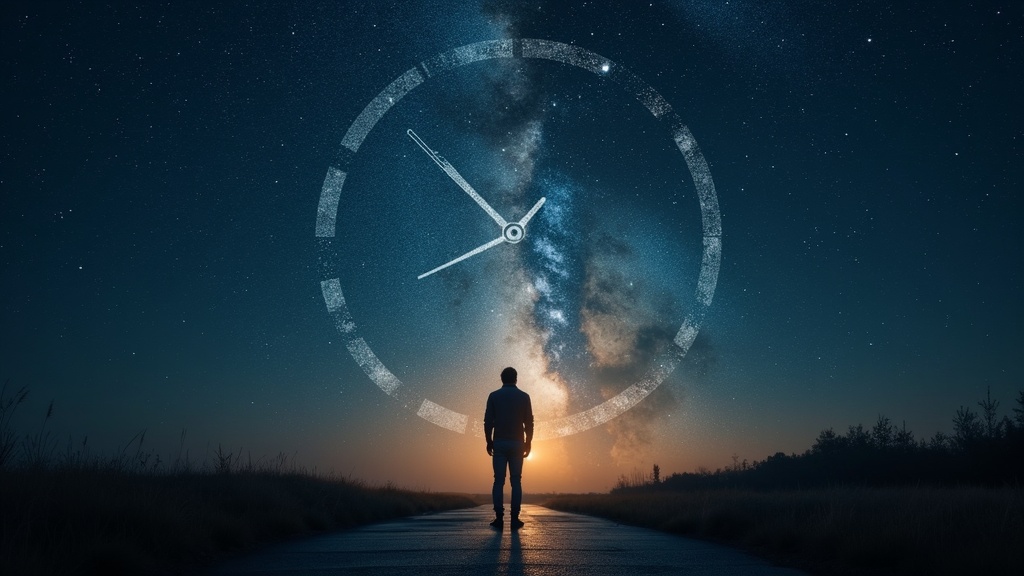
Say the word "now." Whatever just happened as you said it — that's the present, the single slice of time the whole universe is sharing with you. Everywhere, all at once. Right now.
Except it isn't. There is no universal now. And the proof is almost too strange to believe: two people can walk past each other on a sidewalk, and disagree — by days — about what is happening right now in a distant galaxy. Not because one of them is wrong. Because both of them are right.
By the end of this, the word "now" is going to fall apart in your hands. Let's start with a train.
The Death of Simultaneous
Einstein's relativity did a lot of violent things to common sense, but this might be the quietest and the deepest: it killed the idea of "at the same time."
Picture a train moving fast down a track, and lightning striking both ends at once. A person standing on the ground, exactly halfway between the strikes, sees the two flashes arrive together. Simultaneous. No question.
Now put a second person at the exact center of the moving train. As the light travels inward from both ends, she is rushing toward the flash from the front and away from the flash from the back. So the front flash reaches her first. From inside the train, the front was struck before the back. The strikes were not simultaneous at all.
Here's the part that breaks people. Neither of them is making a mistake. There is no hidden truth where the strikes "really" were or weren't simultaneous. Simultaneity — whether two separated events happen at the same time — genuinely depends on how you are moving. Motion tilts your sense of "now."
On a train, the effect is a sliver of a second. But that tilt doesn't stay small. Stretch it across the universe, and it becomes monstrous.
The Andromeda Paradox
In 1989, the physicist Roger Penrose gave this its most haunting form. It's called the Andromeda paradox.
Andromeda is the big galaxy next door — about two and a half million light-years away. Now imagine two ordinary people on Earth, walking past each other on the street. One is strolling in the rough direction of Andromeda. The other is walking the opposite way. Walking. A few feet per second.
Because their sense of "now" is tilted by their motion, their two definitions of "this instant, out at Andromeda" don't match. And across two and a half million light-years, that tiny tilt is amplified into something enormous. Their present moments at Andromeda are separated by days.
Let me make that concrete. Penrose's version: suppose an alien fleet in Andromeda is deciding whether to launch an invasion of Earth. For the person walking one way, the decision hasn't been made yet — it's still in the future. For the person walking the other way, brushing past them on the sidewalk, the fleet has already launched. Same street. Same moment, as they pass. Two completely different "nows" out at Andromeda — one where the future is open, one where it's already done.
And the math is unnervingly gentle. The offset in simultaneity is your velocity, times the distance, divided by the speed of light squared. Plug in Andromeda's distance, and a difference in walking speed of just one foot per second shifts your "now" out there by about a full day. You could change what is "currently" happening in another galaxy by picking up your pace.
It's Not a Trick of the Light
Now, your instinct is probably to reach for an escape hatch. Isn't this just about light taking time to travel? Andromeda is two and a half million light-years away — aren't we just seeing old light, and confusing "when we see it" with "when it happened"?
No. And this is the crucial point. This has nothing to do with signal delay, or old light, or what anyone can see. Everyone here already accounts for how long light takes to arrive. The disagreement is about something deeper: which distant events are defined as happening at the same time as you, right now. That definition — the slice of the universe you call "the present" — is tilted by your motion, and the two walkers' slices cut through Andromeda days apart. The light hasn't reached either of them. The disagreement is baked into the shape of spacetime itself.
So if two people on a sidewalk can't agree on the present in Andromeda, and neither is wrong — what does that do to the idea of the present at all?
The Block Universe
Here's where physics hands off to something stranger. I want to be careful — this next step is an interpretation, not a proven fact. But it's the interpretation the paradox keeps pushing people toward.
Think about what we just established. For the walker heading away, the Andromedan fleet launching is a real, fixed event in her present. It's happening now. But that same event is still in the future for the person she just passed. If it's already fixed and real for her, how can it be an open, unwritten future for him?
The cleanest way out is unsettling: maybe the future is not open. Maybe every event — the fleet launching, your birth, your death, this sentence — all of it simply exists, laid out in a four-dimensional block of spacetime. Past, present, and future, equally real, all at once. Physicists call it the block universe. In that picture, "now" isn't a special moment where reality gets created. It's just the particular slice you happen to be looking at — and different observers slice the block at different angles.
Time, in this view, doesn't flow. Nothing is "coming." The river was never moving. You are moving through it — a single, thin slice of awareness, sweeping across a landscape of moments that were all already there.
The Present Is Local
So — was "now" a lie?
Not a lie, exactly. Just a lot smaller than it feels. Your "now" is real — but it's yours. It's a single slice through spacetime, tilted by how you move, and it does not extend cleanly across the universe. Out at any real distance, your present and someone else's — someone merely walking past you — peel apart into different worlds. There is no master clock. There is no cosmic instant ticking for everyone. The word "now," said out loud, reaches about as far as your own body and then quietly stops meaning anything.
The universe never agreed on a single present moment. We just assumed it did, because here, on this slow little planet, moving slowly past each other, the slices almost line up.
Almost.
If that unsettled the ground under the word "now" — good. That's what this channel is for. The universe doesn't share your present. It never did.
Sources
- Rietdijk–Putnam argument & Penrose's Andromeda paradox: https://en.wikipedia.org/wiki/Rietdijk%E2%80%93Putnam_argument
- Roger Penrose, The Emperor's New Mind (1989)
- Relativity of simultaneity (Einstein's train): https://en.wikipedia.org/wiki/Relativity_of_simultaneity