You Are Part Virus (8% of Your DNA)
Somewhere in the 3 billion letters of your DNA are the corpses of ancient viruses — and they make up about 8% of your entire genome, four times more than the genes that actually build your body. Most are silent fossils.
The Unintuitive Universe · July 14, 2026
And it’s been measured. Every claim traced to the published research. Method & sources ↗
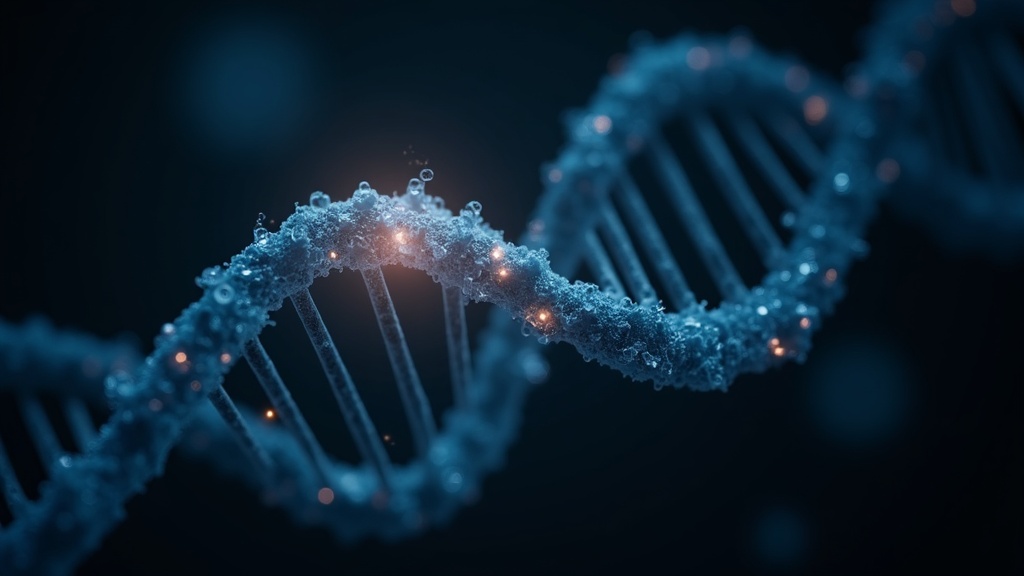
Somewhere in the three billion letters of your DNA — the code that builds every cell in your body — there are the corpses of ancient viruses. Not one or two. They make up about eight percent of your entire genome. To put that in perspective: the genes that actually build you, that code for every protein in your body, are only about one to two percent. You are carrying four times more dead virus than working blueprint.
And here is the part that should stop you cold. At least one of those viruses was not just buried and forgotten. It was captured, tamed, and put to work — and the job it does is build the organ that let you be born at all.
You are, in a real and literal sense, part virus. Let me show you how they got in, and what one of them became.
The Passengers That Never Left
Start with how a virus becomes part of you forever.
Most viruses infect you, hijack some cells, and get cleared. They come and go. But one family, the retroviruses, plays a longer game. A retrovirus takes its own genetic material and splices it directly into the DNA of the cell it infects. It doesn't just visit the cell — it rewrites the cell's permanent code to include itself.
Usually that happens in ordinary body cells, and it dies with you. But every so often, across the deep history of our ancestors, a retrovirus infected a sperm cell or an egg cell — a cell that becomes a child. And when that happens, the virus's DNA is no longer just in one person. It's in the blueprint passed to the next generation, and the next, and every generation after that. The virus becomes heritable. A permanent passenger, copied into every cell of every descendant, forever.
Do that over tens of millions of years, with virus after virus, and the wreckage piles up. Today, roughly eight percent of your genome is the fossilized remains of these invaders — endogenous retroviruses. Most of them are broken now, silenced, inert. Genetic tombstones. But "most" is not "all."
The Virus That Was Domesticated
Because evolution is the ultimate scavenger. It does not care where a useful piece of code comes from. And sitting in that pile of viral wreckage was a gene too good to waste.
Think about what a virus needs to do to infect you. It has to fuse its outer envelope with your cell's membrane — to break through the wall and merge with the cell. Retroviruses carry a specialized gene, called an envelope gene, whose entire purpose is that: fusion. Merging one membrane with another. It is a molecular tool for making two cells become one.
Now think about what a placenta has to do. As an embryo implants, certain cells have to fuse together into a single, giant, continuous sheet with many nuclei — a layer called the syncytiotrophoblast. This sheet is the border crossing between mother and child: it's where oxygen and nutrients pass from her blood to yours, and it keeps the two of you from rejecting each other. To build it, cells have to merge. You need a tool for making two cells become one.
Our ancestors already had one. It was sitting in the viral junk.
The gene is called syncytin, and it is, straight up, a captured viral envelope gene. The exact tool a retrovirus once used to fuse into our cells was repurposed — domesticated — to fuse our own cells together into a placenta. The weapon became an organ. Without working syncytin, the placenta doesn't form properly. Which means, without a virus our ancestors caught and kept, mammals like us could not be born the way we are.
Caught Again and Again
If that were a one-time fluke, it would already be astonishing. It isn't.
When scientists looked across the mammal family tree, they found syncytin genes doing the same placental job in primates, in rodents, in rabbits, in carnivores, in cows. But here's the twist: they're not all the same gene. Different branches of mammals domesticated different viruses, captured at different times, and each independently turned its own retrovirus's fusion gene into its own version of syncytin.
The placenta — the defining organ of placental mammals, the thing that separates us from creatures that lay eggs — was not invented once. It was enabled over and over, in lineage after lineage, by whatever retrovirus happened to be lying around, waiting to be tamed. Evolution reached into the same box of viral tools again and again and pulled out the same solution. Life kept getting rescued by the very things trying to invade it.
The Blurry Line
So sit with what that means about you.
You think of viruses as the enemy — invaders, something separate from you, something to fight off. And in the moment, they are. But zoom out to the scale of deep time, and the border between "you" and "virus" dissolves into a smear. About eight percent of your genome is their descendants. Some of that dead viral code quietly regulates your genes and your immune system. And one piece of it, a hijacker's fusion weapon, is the reason you had a placenta — the reason you grew, the reason you were born instead of hatched.
You did not just survive the viruses of the deep past. You are partly made of them. They lost the war, and their bodies became your blueprint. The most intimate machinery of human reproduction — the very first organ that ever kept you alive — runs on a gene that a virus brought, and your ancestors never gave back.
You are part virus. And one of those viruses built the place where you began.
That's the fine print on being human — and reading it is exactly what this channel is for.
Sources
- Mi et al., "Syncytin is a captive retroviral envelope protein involved in human placental morphogenesis," Nature 2000: https://www.nature.com/articles/35001608
- Independent capture of syncytins across mammals: https://pmc.ncbi.nlm.nih.gov/articles/PMC3610889/