
Widening a Channel Can Make a Friction-Free Fluid Flow Worse
ETH Zurich physicists discovered a quantum resistance paradox in defect-free superfluids: widening a narrow channel can actually increase flow resistance during the dimensional crossover from 1D to 2D.
Priya Ramaswamy 5 min read

Listen to this article
6 minRead aloud by an AI voice. Get the podcast
In classic electronics and fluid dynamics, the rules of conduit size are straightforward: widening a channel reduces resistance. Narrow pipes constrict flow; wide pipes open the floodgates.
Quantum mechanics does not obey classic plumbing.
In a study published in Nature, a team of physicists led by Simon Wili, Meng-Zi Huang, and Tilman Esslinger at ETH Zurich demonstrated that when a defect-free superfluid moves through a narrow channel, widening the path can actually make it harder for the fluid to flow (Nature). Resistance reaches a distinct minimum at the boundary between one dimension and two dimensions, producing a non-monotonic transport paradox where broadening the geometry increases energy dissipation (arXiv).
Measured.
Isolation from Disorder
In solid-state superconductors or liquid helium, measuring how geometry alone dictates dissipation is notoriously difficult (JClub). Physical wires and microfluidic channels carry impurities, lattice defects, and surface roughness. These structural flaws scatter particles, creating resistance that masks the intrinsic behavior of the quantum fluid (JClub).
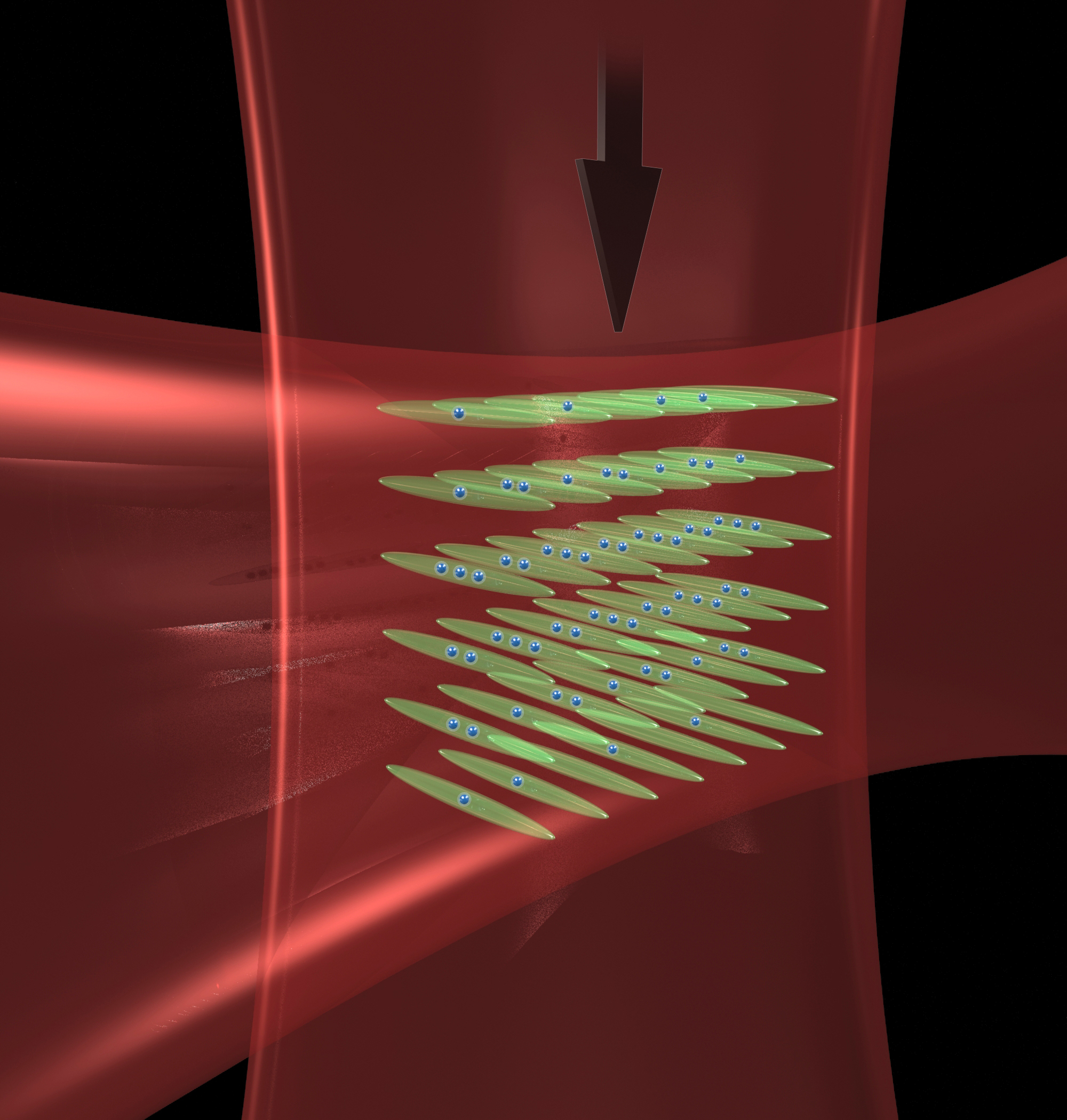
To strip away environmental noise, the ETH Zurich researchers built a clean-room analog out of light (Research Collection). They trapped a cloud of ultracold lithium-6 atoms, forming a strongly interacting, defect-free unitary Fermi gas (Nature). Using a digital micromirror device (DMD), the team projected laser beams to carve out two superfluid reservoirs connected by a short, flat channel (Research Collection).
Because the channel walls were formed entirely by smooth optical potentials, there were no physical impurities or lattice defects to bump into (Nature). Any energy loss measured during transport had to originate entirely from the fluid’s internal dynamics and the geometry of the constriction (Nature).
The experimenters set the two reservoirs out of balance, allowing the atom cloud to oscillate back and forth through the central canal (Happy Daze). By tracking how quickly the sloshing motion died out over time, they directly measured the channel’s quantum resistance (Nature).
The Phase Slip and the Vortex
A superfluid has zero viscosity in steady, low-velocity flow, but it is not immune to dissipation (Research Collection). When pushed hard enough through a restriction, the quantum wave function describing the system undergoes localized breakdown events that shed kinetic energy (Research Collection).
How that energy breaks down depends on the dimensionality of the channel:
- In strict quasi-one-dimensional channels, the geometry is too narrow for circulation loops to form (Research Collection). Instead, the fluid dissipates energy via quantum phase slips (Nature). Thermal or quantum fluctuations momentarily drop the superfluid density to zero across a cross-section of the channel, causing the quantum phase gradient to slip by $2\pi$ and releasing a burst of energy (Research Collection). The team confirmed that their narrow-channel transport data fit the Langer-Ambegaokar-McCumber-Halperin (LAMH) theory of phase slips, exhibiting exponential scaling of the activation barrier across more than ten orders of magnitude (arXiv).
- In wider, quasi-two-dimensional channels, the constraint lifts enough for topological defects to move laterally (Research Collection). Dissipation shifts to the creation and transit of quantized vortex-antivortex pairs cutting across the channel width (Nature). The team matched this wide-channel behavior to a finite-size vortex model (JClub).
The Crossover Minimum
The paradox occurs in the transition zone between these two well-understood regimes (Nature).
As the ETH Zurich group widened the channel starting from a microscopic quasi-1D width, the rate of 1D phase slips dropped precipitously (arXiv). The energy barrier required to pinch off the order parameter grew larger, making phase slips increasingly rare (Research Collection). Consequently, resistance dropped as the channel grew wider, just as classical intuition dictates (Happy Daze).
However, before the channel became wide enough for 2D vortices to form easily, the system hit an intermediate geometry (Nature). At this specific crossover width, the channel was too wide for phase slips to occur frequently, but still too narrow for 2D vortices to enter and cross comfortably (JClub). Both major dissipative channels were simultaneously suppressed (JClub).
This structural sweet spot produced a global minimum in resistance (arXiv).
When the researchers opened the light channel slightly beyond this sweet spot, entering the quasi-2D regime, vortex creation became kinetically allowed (Nature). Resistance rose again (arXiv). Widening the conduit created more room for topological defects to swirl, turning a wider channel into a more resistive one (Happy Daze).
By mapping the entire curve without the confounding background of physical material defects, the experiment isolated geometry as an independent variable in quantum transport (Nature). The underlying mechanics demonstrate that low-dimensional dissipation is not a continuous, uniform decline from narrow to wide, but a competition between topological decay modes that leaves a quiet valley right at the border of dimension (JClub).
This article is AI-generated (synthetic) content, produced by an automated editorial system with human direction and review. Every claim is traced to published, peer-reviewed sources.