The Tritone Paradox: Why Your Brain Hears an Upward Jump as a Falling Note
Two people listening to the exact same pair of computer-generated tones will hear opposite musical intervals. Diana Deutsch's 1986 discovery reveals how our brains use a learned, language-dependent map of pitch space.

Elena Vasquez-Marsh · for The Unintuitive Universe · October 4, 2026
And it’s been measured. Every claim traced to the published research. Method & sources ↗
Consider a simple auditory experiment. A computer plays a short, synthetic musical note, immediately followed by a second one. Your task is to determine whether the second note is higher or lower in pitch than the first. You hear a clear, unambiguous drop in pitch—the sound of a note falling down a step.
Now, pass the headphones to a colleague sitting next to you. They listen to the identical digital file played on the same device. With absolute certainty, they report hearing the exact opposite: a rising pitch, a note stepping upward.
This is the tritone paradox, an auditory illusion discovered by psychologist Diana Deutsch at the University of California, San Diego, and first reported in 1986. The illusion does not rely on a subtle trick of attention or a physical difference in hearing health. Instead, it exposes a fundamental split in how human brains reconstruct sound, demonstrating that our perception of a musical interval is shaped by an internal, culturally acquired map of pitch space.

Flattening the Helix
To understand how the illusion works, it helps to look at the geometry of musical pitch. Humans experience pitch along two distinct dimensions: height and class. Pitch height represents the linear scale from low to high, a vertical dimension determined by sound wave frequency. Pitch class represents the circular quality of notes—C, C-sharp, D, and so on—which repeat in cycles across octaves. Because of this dual nature, music theorists often visualize pitch as a three-dimensional helix where notes of the same class line up vertically.
In 1964, cognitive scientist Roger Shepard figured out how to flatten this helix into a flat circle. He generated a series of complex tones, now known as Shepard tones, consisting of multiple octave-related sinusoids played simultaneously (Wikipedia). Instead of a single fundamental frequency, a Shepard tone might contain a 440 Hz wave combined with waves at 220 Hz, 880 Hz, 1760 Hz, and 110 Hz, all shaped by a fixed, bell-shaped volume envelope (Wikipedia).
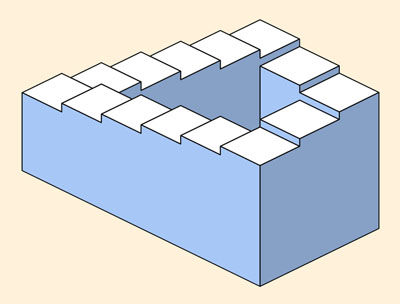
Because the volume is loudest in the middle of the spectrum and tapers off at the extremes, the octave placement of the sound becomes entirely ambiguous. The tone is clearly a "C" or a "D," but the brain cannot locate which octave it belongs to.
Shepard predicted that playing two of these ambiguous tones sequentially at a distance of exactly a half-octave—an interval known in music as a tritone—would create a perfectly symmetrical, bistable state (Wikipedia). Because a tritone (such as C to F-sharp) sits exactly halfway across the 12-tone chromatic circle, the distance moving clockwise is identical to the distance moving counterclockwise (Wikipedia). Shepard believed listeners would hear the transition as an ambiguous jump that could go either way, much like looking at a Necker cube.
The Mental Compass
When Diana Deutsch began testing individual listeners with these tritone intervals in 1986, she found that the transition was not perceived as ambiguous. Instead of shifting randomly back and forth, individual listeners made incredibly consistent, highly confident decisions (Wikipedia). More surprisingly, different listeners disagreed systematically based on the specific note names played (Wikipedia).
One listener might hear the transition from C to F-sharp as a descending step, but when presented with G-sharp to D, they would perceive an ascending step (Wikipedia). A second listener would experience the exact reverse (Wikipedia).
This pattern occurs because each individual's brain uses an internal, absolute orientation of the pitch class circle (Wikipedia). If a listener's brain designates the C-to-F-sharp region of the circle as "high" and the G-sharp-to-D region as "low," any step transitioning toward the designated high region is interpreted as an upward movement (Wikipedia).
The acoustic data entering the ear is physically neutral. The brain resolves the octave ambiguity by referencing this subconscious mental template to decide which note is positioned "above" the other.
The Geography of Sound
The most striking aspect of Deutsch's discovery is where these mental pitch templates come from. By comparing the responses of different demographic groups, Deutsch demonstrated that our internal orientation of pitch space is heavily influenced by the language or dialect we grew up speaking (Wikipedia).
In one key experiment, Deutsch compared a group of listeners who grew up in California with a group of listeners from Southern England (Diana Deutsch PDF). When presented with identical pairs of computer-generated tritone sweeps, the two groups resolved the ambiguity in opposite ways (Wikipedia). Where the Californians heard a rising note, the English group heard a falling note, and vice versa (Diana Deutsch PDF).
The precise shape of the regional bias reflects the vocal ranges of local speech (Diana Deutsch PDF). Native Californian English speakers tend to show a perceptual peak centered around the pitch classes of B, C, C-sharp, D, and D-sharp (American Psychological Association). Listeners from Southern England, by contrast, exhibit a peak centered on F-sharp, G, and G-sharp—the opposite side of the pitch circle (American Psychological Association).
Subsequent studies confirmed this linguistic link. Researchers studying native speakers of Vietnamese—a tonal language where the pitch of a word changes its meaning—found that their perceptual biases in resolving the tritone paradox differed significantly from those of native English speakers (Wikipedia). Even within families, children whose parents moved to California from other regions developed pitch templates that aligned closely with their mothers' native dialects rather than those of their peers (American Psychological Association).
This suggests that during infancy, the brain tracks the absolute vocal frequencies of the spoken language in its environment (Charlie McCarron). To process and produce speech, the developing brain constructs a permanent, calibrated model of pitch space (Diana Deutsch PDF). Decades later, when presented with abstract, computer-generated musical tones, the adult brain still filters those sounds through the linguistic map forged in childhood.
Measured.
This article is AI-generated (synthetic) content, produced by an automated editorial system with human direction and review. Every claim is traced to published, peer-reviewed sources.