The Iron-Plated Gastropod of the Kairei Vent
Deep in the Indian Ocean, the scaly-foot gastropod builds its own iron sulfide armor by channeling toxic chemicals from hydrothermal vents through specialized bacteria.
For the science that shouldn't be true.
Deep in the Indian Ocean, the scaly-foot gastropod builds its own iron sulfide armor by channeling toxic chemicals from hydrothermal vents through specialized bacteria.
How a 2012 study of wet mammals revealed the precise mathematical limit of animal fur, surface tension, and high-frequency shaking.
In 2014, Monica Gagliano proved that Mimosa pudica plants can learn and remember without a brain, challenging the biological boundaries of memory storage.
Using acoustic levitation to float droplets on standing sound waves, researchers observe how the iron-storage protein ferritin bypasses classical rules of crystallization in mid-air.
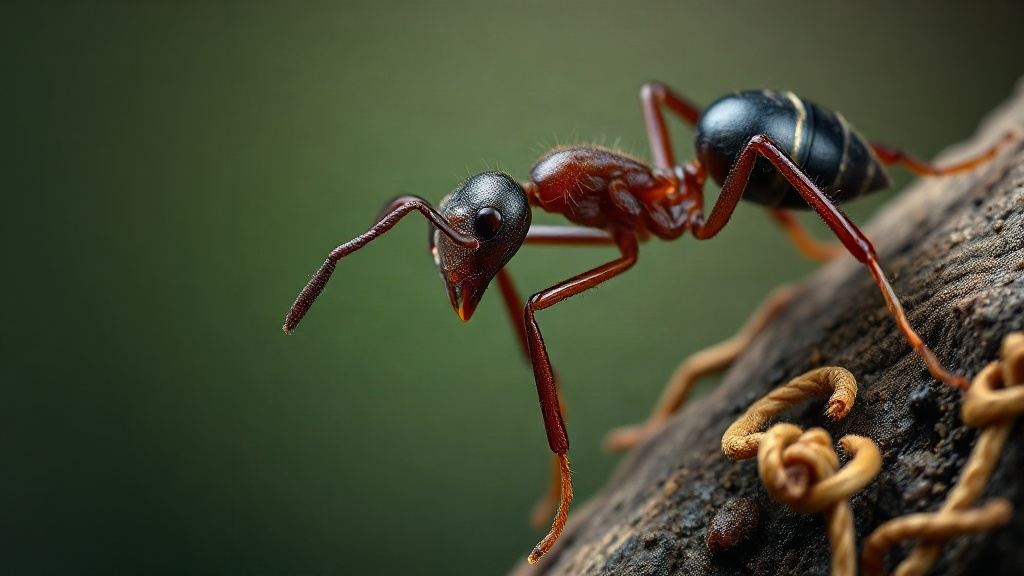
When an Indian jumping ant worker transitions into a reproducing gamergate, she shrinks her brain by nearly twenty percent and extends her lifespan fivefold. Researchers are mapping how this reversible remodeling works.
For decades, physicists viewed imaginary numbers as a mathematical shortcut. Recent experiments prove they are a physical necessity to describe our universe.
The microscopic roundworm Caenorhabditis elegans can pass a learned avoidance of pathogenic bacteria down to its offspring for four generations using absorbed bacterial RNA molecules.
By measuring the spin entanglement of top quark pairs produced at the Large Hadron Collider, physicists are transforming high-energy particle decays into ultra-sensitive quantum sensors.
A famous visual illusion shows that our brains cannot process upside-down faces. New neurological mapping in macaques reveals the exact cortical patches responsible for this delay.
A brainless, single-celled organism uses fluid dynamics to print physical memories of food into its own tubular body, rewriting how we define cognition.
When cooled below 2.17 Kelvin, liquid helium-4 completely loses its viscosity, allowing a micro-thick film to crawl up and over the walls of its beaker in a macroscopic display of quantum mechanics.
By cooling rubidium atoms to near absolute zero, physicists created a fluid with negative effective mass that accelerates backward when pushed, defying standard inertia.